Why this matters now
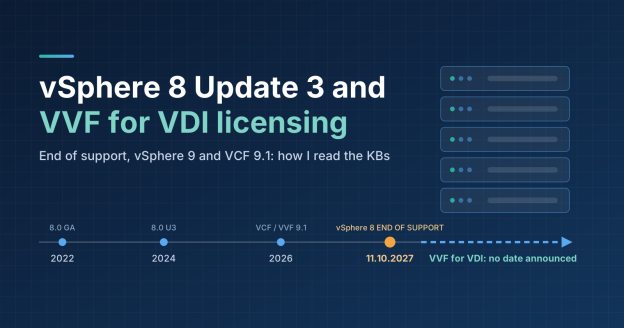
If you run Omnissa Horizon on vSphere 8 Update 3 with VMware vSphere Foundation for VDI (VVF for VDI) licenses, you are probably wondering whether the vSphere 8 end of general support on October 11, 2027 applies to you. Reading the dedicated Broadcom KB and the Omnissa FAQ on the combined offering, my interpretation is that this date does not apply to VVF for VDI.
With about a year to go, many customers are planning renewals and migrations. In this post I share how I interpret the official Broadcom and Omnissa documentation and what I would do in practice. I also use the acronyms VVF (VMware vSphere Foundation, the per-core offering sold by Broadcom) and VCF (VMware Cloud Foundation).
Links to all the official documents cited are at the end of the article.
The vSphere 8 deadline (and therefore 8.0 Update 3)
General support for vSphere 8 ends on October 11, 2027, followed by technical guidance until October 11, 2029. Update 3, released in July 2024, is the last update in this branch and follows the same dates.
|
Milestone |
Date |
|---|---|
|
vSphere 8.0 general availability |
October 11, 2022 |
|
vSphere 8.0 Update 3 GA |
Jun 25, 2024 |
|
End of general support |
October 11, 2027 |
|
End of technical guidance |
October 11, 2029 |
These dates apply to “classic” editions such as vSphere Enterprise Plus 8. For VVF for VDI, in my view, the picture is different, and the reference is Broadcom KB 428674.
As I read it, the KB states that the end-of-support date announced for vSphere Enterprise Plus 8 does not cover VVF for VDI or its vSphere component. As of the KB date (February 9, 2026), Broadcom states it has made no EOS or EOL announcements for VVF for VDI or any of its components.
The stated reason is formal but, in my opinion, important: Broadcom describes VVF for VDI as a standalone product with its own lifecycle and roadmap, not as a bundle of separate products. Any future dates should appear in the Broadcom Lifecycle Matrix.
The Omnissa FAQ (KB 6000381) points the same way. As I interpret it, the October 11, 2027 date does not affect vSphere 8 support for customers who bought Horizon with VVF for VDI, because its lifecycle is independent of vSphere Enterprise Plus purchased from Broadcom. As of this post (October 12, 2026), I have found no later KBs that change the picture.
I also checked the Broadcom Lifecycle Matrix: as of this post, it shows no end-of-support or end-of-life dates for VVF for VDI.
VVF for VDI licensing
VMware vSphere Foundation for VDI (VVF for VDI) is the infrastructure component of the combined offerings that Omnissa has sold alongside Horizon since May 2024. The reference is the Omnissa FAQ KB 6000381.
The points that matter most, in my reading of the FAQ:
Watch out for vSphere 9
From the Omnissa FAQ I understand that VVF for VDI includes only vSphere 8. Horizon 8 already supports VCF and VVF 9.x from releases 2503 and 2506, but to move to vSphere 9 the FAQ says you must buy VCF or VVF separately from Broadcom. Broadcom KB 439672 seems to confirm this: it lists only VVF and VCF as eligible for a 9.x upgrade.
What about VCF 9.1?
VCF 9.1 has been available since May 25, 2026, and version 9.1 also ships as VVF 9.1. As far as I understand, then, “standard” VVF licenses can be used on the 9.1 platform (Broadcom announcement).
What I took from the Broadcom documentation:
On the Horizon side, according to the Omnissa Interoperability Matrix, vCenter Server 9.1 and ESX 9.1 are supported starting with Horizon 8 2603. Earlier releases, including 2512.1, are not listed as compatible with 9.1.
|
Horizon version |
Supported vCenter Server |
Supported ESX/ESXi |
|---|---|---|
|
Horizon 2606 |
9.1, 9.0, 8.0 (GA, U1, U2, U3), 7.0 (GA, U1, U2, U3) |
9.1, 9.0, 8.0 (GA, U1, U2, U3), 7.0 (GA, U1, U2, U3) |
|
Horizon 2603 |
9.1, 9.0, 8.0 (GA, U1, U2, U3), 7.0 (GA, U1, U2, U3) |
9.1, 9.0, 8.0 (GA, U1, U2, U3), 7.0 (GA, U1, U2, U3) |

The sore point, in my view, remains VVF for VDI: from the KBs I have read, it does not entitle you to 9.x licenses, not even for 9.1. In my reading, running Horizon 2603 or later on vSphere 9.1 today requires a VVF or VCF entitlement purchased from Broadcom, with Horizon licensed without the VVF for VDI component.
What I would do in practice
Conclusions
As I interpret the KBs, Horizon customers on VVF for VDI can keep treating vSphere 8.0 Update 3 as their reference platform: I see no announced end-of-support date and, for now, it is also the only version included. The paradox is that the same license that seems to shield you from the 2027 deadline also blocks the move to vSphere 9.
Customers on traditional vSphere licenses, on the other hand, should circle October 11, 2027 in red. Either way, it is worth keeping an eye on the KBs cited, as they may be updated over time.