vSphere 8 Update 3 and VVF for VDI licensing: what changes

Why this matters now

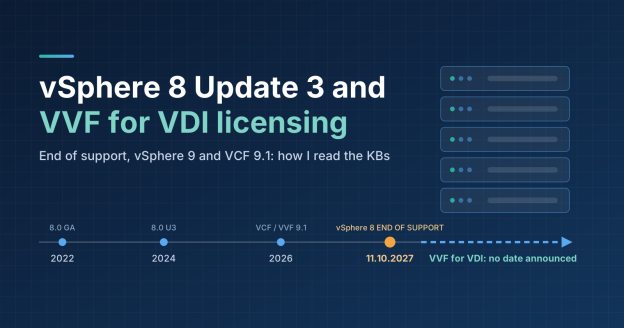
If you run Omnissa Horizon on vSphere 8 Update 3 with VMware vSphere Foundation for VDI (VVF for VDI) licenses, you are probably wondering whether the vSphere 8 end of general support on October 11, 2027 applies to you. Reading the dedicated Broadcom KB and the Omnissa FAQ on the combined offering, my interpretation is that this date does not apply to VVF for VDI.

With about a year to go, many customers are planning renewals and migrations. In this post I share how I interpret the official Broadcom and Omnissa documentation and what I would do in practice. I also use the acronyms VVF (VMware vSphere Foundation, the per-core offering sold by Broadcom) and VCF (VMware Cloud Foundation).

Links to all the official documents cited are at the end of the article.

The vSphere 8 deadline (and therefore 8.0 Update 3)

General support for vSphere 8 ends on October 11, 2027, followed by technical guidance until October 11, 2029. Update 3, released in July 2024, is the last update in this branch and follows the same dates.

Milestone

Date

vSphere 8.0 general availability

October 11, 2022

vSphere 8.0 Update 3 GA

Jun 25, 2024

End of general support

October 11, 2027

End of technical guidance

October 11, 2029

.

These dates apply to “classic” editions such as vSphere Enterprise Plus 8. For VVF for VDI, in my view, the picture is different, and the reference is Broadcom KB 428674.

As I read it, the KB states that the end-of-support date announced for vSphere Enterprise Plus 8 does not cover VVF for VDI or its vSphere component. As of the KB date (February 9, 2026), Broadcom states it has made no EOS or EOL announcements for VVF for VDI or any of its components.

The stated reason is formal but, in my opinion, important: Broadcom describes VVF for VDI as a standalone product with its own lifecycle and roadmap, not as a bundle of separate products. Any future dates should appear in the Broadcom Lifecycle Matrix.

The Omnissa FAQ (KB 6000381) points the same way. As I interpret it, the October 11, 2027 date does not affect vSphere 8 support for customers who bought Horizon with VVF for VDI, because its lifecycle is independent of vSphere Enterprise Plus purchased from Broadcom. As of this post (October 12, 2026), I have found no later KBs that change the picture.

I also checked the Broadcom Lifecycle Matrix: as of this post, it shows no end-of-support or end-of-life dates for VVF for VDI.

VVF for VDI licensing

VMware vSphere Foundation for VDI (VVF for VDI) is the infrastructure component of the combined offerings that Omnissa has sold alongside Horizon since May 2024. The reference is the Omnissa FAQ KB 6000381.

The points that matter most, in my reading of the FAQ:

•Contents: vSphere Enterprise Plus (per user), vCenter Standard, vSAN Enterprise and Tanzu. It does not include NSX, SDDC Manager or Aria Operations.
•Metric: per user, Named User or Concurrent User, with terms from 1 to 5 years. Each user nominally equals one VM, but you can run as many VMs as needed to serve the licensed users.
•vSAN: 100 GiB of raw capacity per physical core in the vSAN cluster, with no option to buy extra capacity. For more space you need to assign more cores or move to VVF/VCF. Broadcom’s VVF, by comparison, includes 250.
•Permitted use: virtual desktops, RDSH and the infrastructure VMs Horizon needs (Connection Servers, App Volumes Managers, events database, domain controllers for VDI users). Third-party applications and databases used by end users do not qualify.
•Support: Omnissa is always the first point of contact and escalates to Broadcom when needed.
•Separate product: despite the name, VVF for VDI and Broadcom’s VVF are different, independent SKUs.

Watch out for vSphere 9

From the Omnissa FAQ I understand that VVF for VDI includes only vSphere 8. Horizon 8 already supports VCF and VVF 9.x from releases 2503 and 2506, but to move to vSphere 9 the FAQ says you must buy VCF or VVF separately from Broadcom. Broadcom KB 439672 seems to confirm this: it lists only VVF and VCF as eligible for a 9.x upgrade.

What about VCF 9.1?

VCF 9.1 has been available since May 25, 2026, and version 9.1 also ships as VVF 9.1. As far as I understand, then, “standard” VVF licenses can be used on the 9.1 platform (Broadcom announcement).

What I took from the Broadcom documentation:

•One installer, two products: the VCF Installer deploys both VCF and VVF 9.1. Customers with a VCF entitlement can choose to install full VCF or just VVF (KB 440630).
•New License Server: in 9.1 licenses are managed by a dedicated appliance, mandatory for both VCF and VVF. Without the License Server and VCF Management Services, upgraded hosts stay in evaluation mode (KB 442133).
•Mixed licenses in one vCenter: 9.1 lets you manage several license types under a single vCenter, where separate instances were needed before (VMware blog).

On the Horizon side, according to the Omnissa Interoperability Matrix, vCenter Server 9.1 and ESX 9.1 are supported starting with Horizon 8 2603. Earlier releases, including 2512.1, are not listed as compatible with 9.1.

Horizon version

Supported vCenter Server

Supported ESX/ESXi

Horizon 2606

9.1, 9.0, 8.0 (GA, U1, U2, U3), 7.0 (GA, U1, U2, U3)

9.1, 9.0, 8.0 (GA, U1, U2, U3), 7.0 (GA, U1, U2, U3)

Horizon 2603

9.1, 9.0, 8.0 (GA, U1, U2, U3), 7.0 (GA, U1, U2, U3)

9.1, 9.0, 8.0 (GA, U1, U2, U3), 7.0 (GA, U1, U2, U3)

.

The sore point, in my view, remains VVF for VDI: from the KBs I have read, it does not entitle you to 9.x licenses, not even for 9.1. In my reading, running Horizon 2603 or later on vSphere 9.1 today requires a VVF or VCF entitlement purchased from Broadcom, with Horizon licensed without the VVF for VDI component.

What I would do in practice

1.Check the license type on every ESXi host: VVF for VDI, VVF, VCF or perpetual vSphere. The October 11, 2027 date means different things depending on the license.
2.With VVF for VDI, stay on vSphere 8.0 Update 3 and keep it patched; don’t plan a vSphere 9 upgrade without a VVF or VCF entitlement purchased from Broadcom.
3.Renew before the earliest expiration date: Horizon and VVF for VDI dates can differ. VVF for VDI keys have no grace period and Omnissa’s “do not deny” policy does not cover them: if they expire, the Horizon environment may stop working.
4.Separate non-VDI workloads: VMs that don’t directly serve Horizon need VVF or VCF licenses, even in the same cluster.
5.Check vSAN and monitoring: make sure you stay under 100 GiB per core, and remember that Aria Operations is not included and cannot be borrowed from a VVF or VCF license.
6.Check Horizon too: confirm in the Omnissa compatibility matrix that your Horizon 8 release is supported on the vSphere version you run and is not close to end of support.
7.Keep an eye on the KBs: the Broadcom Lifecycle Matrix and KBs 428674 and 6000381 are where any changes will appear.

Conclusions

As I interpret the KBs, Horizon customers on VVF for VDI can keep treating vSphere 8.0 Update 3 as their reference platform: I see no announced end-of-support date and, for now, it is also the only version included. The paradox is that the same license that seems to shield you from the 2027 deadline also blocks the move to vSphere 9.

Customers on traditional vSphere licenses, on the other hand, should circle October 11, 2027 in red. Either way, it is worth keeping an eye on the KBs cited, as they may be updated over time.
Sources

vSphere 8 Update 3 and VVF for VDI licensing: what changes

vSphere 8 Update 3 e licenze VVF for VDI: cosa cambia

Perché parlarne adesso

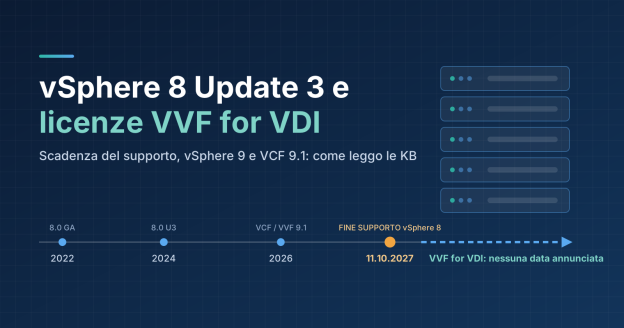
Chi gestisce Omnissa Horizon su vSphere 8 Update 3 con licenze VMware vSphere Foundation for VDI (VVF for VDI) si sta probabilmente chiedendo se la fine del supporto di vSphere 8, fissata all’11 ottobre 2027, valga anche per lui. Leggendo il KB Broadcom dedicato e la FAQ Omnissa sull’offerta combinata, la mia interpretazione è che quella data non si applichi a VVF for VDI.

Manca circa un anno alla scadenza e molti clienti stanno pianificando rinnovi e migrazioni. In questo post riporto come interpreto la documentazione ufficiale di Broadcom e Omnissa e cosa farei in pratica. Nel testo uso anche le sigle VVF (VMware vSphere Foundation, l’offerta per core venduta da Broadcom) e VCF (VMware Cloud Foundation).

I link a tutti i documenti ufficiali citati sono in fondo all’articolo.

La scadenza di vSphere 8 (e quindi di 8.0 Update 3)

Il supporto generale di vSphere 8 termina l’11 ottobre 2027, seguito dalla technical guidance fino all’11 ottobre 2029. Update 3, uscito a luglio 2024, è l’ultimo update di questo ramo e segue le stesse date.

Fase

Data

General availability vSphere 8.0

11 ottobre 2022

GA vSphere 8.0 Update 3

25 giugno 2024

Fine supporto generale

11 ottobre 2027

Fine technical guidance

11 ottobre 2029

.

Queste date valgono per le edizioni “classiche” come vSphere Enterprise Plus 8. Per VVF for VDI, a mio modo di vedere, il discorso è diverso, e il riferimento è il KB Broadcom 428674.

Per come lo leggo, il KB dice che la data di fine supporto annunciata per vSphere Enterprise Plus 8 non riguarda VVF for VDI né la sua componente vSphere. Alla data del KB (9 febbraio 2026) Broadcom dichiara di non aver fatto annunci di EOS o EOL per VVF for VDI o per i suoi componenti.

Il motivo indicato è formale ma, secondo me, importante: Broadcom descrive VVF for VDI come un prodotto a sé, con ciclo di vita e roadmap propri, e non come un insieme di prodotti separati. Eventuali date future dovrebbero comparire nella Broadcom Lifecycle Matrix.

Anche la FAQ Omnissa (KB 6000381) va nella stessa direzione. Per come la interpreto, la data dell’11 ottobre 2027 non tocca il supporto vSphere 8 per chi ha acquistato Horizon con VVF for VDI, perché il suo ciclo di vita è indipendente da quello di vSphere Enterprise Plus acquistato da Broadcom. Alla data di questo post (12 ottobre 2026) non ho trovato KB successivi che cambino il quadro.

Ho controllato anche la Broadcom Lifecycle Matrix: alla data di questo post non risultano date di fine supporto o di fine vita per VVF for VDI.

Le licenze VVF for VDI

VMware vSphere Foundation for VDI (VVF for VDI) è la componente infrastrutturale delle offerte combinate che Omnissa vende insieme a Horizon dal maggio 2024. Il riferimento è la FAQ Omnissa KB 6000381.

I punti che, dalla mia lettura della FAQ, contano di più:

•Contenuto: vSphere Enterprise Plus (per utente), vCenter Standard, vSAN Enterprise e Tanzu. Non include NSX, SDDC Manager né Aria Operations.
•Metrica: per utente, Named User o Concurrent User, con durate da 1 a 5 anni. Ogni utente vale nominalmente una VM, ma si possono usare tutte le VM necessarie a servire gli utenti licenziati.
•vSAN: 100 GiB di capacità raw per core fisico del cluster vSAN, senza possibilità di acquistare capacità aggiuntiva. Per avere più spazio bisogna assegnare più core o passare a VVF/VCF. La VVF di Broadcom, per confronto, ne include 250.
•Uso consentito: desktop virtuali, RDSH e le VM infrastrutturali che servono a Horizon (Connection Server, App Volumes Manager, database eventi, domain controller degli utenti VDI). Applicazioni e database di terze parti usati dagli utenti non rientrano.
 •Supporto: il primo punto di contatto è sempre Omnissa, che scala a Broadcom quando serve.
•Prodotto distinto: nonostante il nome, VVF for VDI e la VVF di Broadcom sono SKU diversi e indipendenti.

Attenzione a vSphere 9

Dalla FAQ Omnissa capisco che VVF for VDI include solo vSphere 8. Horizon 8 supporta già VCF e VVF 9.x dalle release 2503 e 2506, ma per passare a vSphere 9 la FAQ indica di acquistare VCF o VVF separatamente da Broadcom. Il KB Broadcom 439672 mi sembra confermarlo: per l’upgrade a 9.x indica come idonee solo VVF e VCF.

E VCF 9.1?

VCF 9.1 è disponibile dal 25 maggio 2026 e la versione 9.1 esiste anche come VVF 9.1. Per quanto ho capito, quindi, le licenze VVF “standard” si possono usare sulla piattaforma 9.1 (annuncio Broadcom).

Cosa ho ricavato dalla documentazione Broadcom:

•Stesso installer, due prodotti: il VCF Installer distribuisce sia VCF sia VVF 9.1. Chi ha un entitlement VCF può scegliere se installare VCF completo o solo VVF (KB 440630).
•Nuovo License Server: in 9.1 le licenze sono gestite da un’appliance dedicata, obbligatoria sia per VCF sia per VVF. Senza License Server e VCF Management Services gli host aggiornati restano in licenza di valutazione (KB 442133).
•Licenze miste nello stesso vCenter: 9.1 permette di gestire più tipi di licenza sotto un unico vCenter, mentre prima servivano istanze separate (blog VMware).

Lato Horizon, secondo la Interoperability Matrix di Omnissa, vCenter Server 9.1 ed ESX 9.1 sono supportati a partire da Horizon 8 2603. Le release precedenti, inclusa la 2512.1, non risultano compatibili con la 9.1.

Versione Horizon

vCenter Server supportati

ESX/ESXi supportati

Horizon 2606

9.1, 9.0, 8.0 (GA, U1, U2, U3), 7.0 (GA, U1, U2, U3)

9.1, 9.0, 8.0 (GA, U1, U2, U3), 7.0 (GA, U1, U2, U3)

Horizon 2603

9.1, 9.0, 8.0 (GA, U1, U2, U3), 7.0 (GA, U1, U2, U3)

9.1, 9.0, 8.0 (GA, U1, U2, U3), 7.0 (GA, U1, U2, U3)

.

La nota dolente, a mio avviso, resta VVF for VDI: dalle KB che ho letto non dà diritto a licenze 9.x, nemmeno per la 9.1. Secondo la mia lettura, per portare Horizon 2603 o successivo su vSphere 9.1 oggi serve un entitlement VVF o VCF acquistato da Broadcom, con Horizon licenziato senza la componente VVF for VDI.

Cosa farei in pratica

1.Verifica il tipo di licenza di ogni host ESXi: VVF for VDI, VVF, VCF o vSphere perpetuo. La scadenza dell’11 ottobre 2027 cambia significato a seconda della licenza.
2.Con VVF for VDI resta su vSphere 8.0 Update 3 e mantienilo aggiornato con le patch correnti; non pianificare l’upgrade a vSphere 9 senza un entitlement VVF o VCF acquistato da Broadcom.
3.Rinnova prima della scadenza più vicina: le date di Horizon e di VVF for VDI possono essere diverse. Le chiavi VVF for VDI non hanno periodo di grazia e la policy “do not deny” di Omnissa non le copre: se scadono, l’ambiente Horizon può smettere di funzionare.
4.Separa i carichi non VDI: le VM che non servono direttamente Horizon vanno coperte con licenze VVF o VCF, anche nello stesso cluster.
5.Controlla vSAN e monitoraggio: verifica di stare sotto i 100 GiB per core e ricorda che Aria Operations non è incluso né può essere preso in prestito da una licenza VVF o VCF.
6.Controlla anche Horizon: verifica nella matrice di compatibilità Omnissa che la tua release di Horizon 8 sia supportata sulla versione di vSphere che usi e che non sia vicina alla fine del supporto.
7.Tieni d’occhio i KB: la Broadcom Lifecycle Matrix e i KB 428674 e 6000381 sono i punti in cui comparirà qualsiasi novità.

Conclusioni

Per come interpreto le KB, chi usa Horizon con VVF for VDI può continuare a considerare vSphere 8.0 Update 3 la piattaforma di riferimento: non vedo una data di fine supporto annunciata e, per ora, è anche l’unica versione inclusa. Il paradosso è che la stessa licenza che sembra mettere al riparo dalla scadenza del 2027 impedisce il passaggio a vSphere 9.

Chi ha licenze vSphere tradizionali, invece, ha l’11 ottobre 2027 come data da cerchiare in rosso. In ogni caso vale la pena tenere d’occhio le KB citate, che possono essere aggiornate nel tempo.

Fonti

vSphere 8 Update 3 e licenze VVF for VDI: cosa cambia