SSL Certificates in an Omnissa Horizon + Omnissa Access World: Why They Matter More Than You Think

.

A red lock on a blue background

AI-generated content may be incorrect.Let’s be honest: certificates are not the most exciting thing in IT. They don’t sparkle, they don’t blink, and they rarely impress your CIO in a slide deck. But if you’re running an Omnissa Horizon environment (also with Omnissa Access integration), SSL certificates are the unsung heroes that make your infrastructure secure, trusted, and usable.

In this post, let’s break down why certificates matter, where they should live in your Horizon world, and how they unlock some pretty cool features like True SSO.

.

.

The Basics: Why SSL Certificates?

At their core, SSL/TLS certificates do three things:

1.Encrypt traffic – so that nobody can sniff your users’ RDP or Blast traffic.
2.Prove identity – so your clients know they’re talking to the real Horizon server, not some sneaky impostor.
3.Build trust – because “untrusted certificate” pop-ups are the fastest way to kill user confidence.

In Horizon, these are not “nice to haves”—they’re essential.

.

Public vs Internal CA: Which Flavor Do You Need?

In most deployments, you’ll be juggling two kinds of certificates:

• Public CA Certificates: Perfect for components exposed to the internet—like your Unified Access Gateways (UAGs). Public certs ensure that external clients (home users, contractors, BYOD devices) connect without scary warnings.
• Internal Microsoft CA Certificates: Handy for internal components—like Connection Servers—especially if all your clients are domain-joined and trust your Microsoft enterprise CA. They’re cheaper (sometimes free) and give you tighter control.

Pro tip: You don’t have to pick one or the other. Most production environments mix both.

.

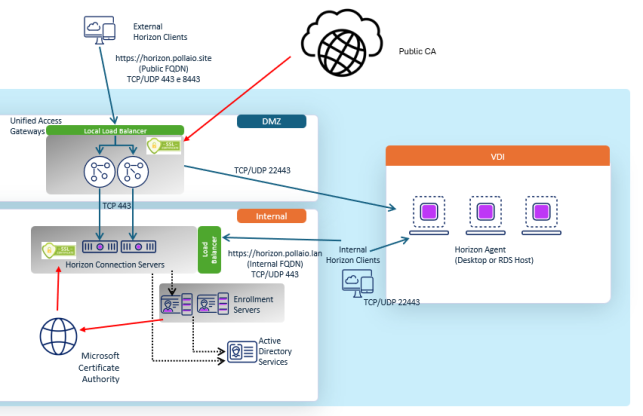
Certificates in the Horizon Architecture (The Big Picture)
.

A screenshot of a computer

AI-generated content may be incorrect.

.

Think of the certificates as passports:

• The UAG needs a passport recognized globally (public CA).
• The Connection Servers can survive with a local passport (internal CA).
• True SSO hands out temporary passports at the border (short-lived certs) so users don’t need to fumble with passwords.

.

Certificates on Connection Servers

Your Horizon Connection Servers are the brains of the operation. By default, they come with a self-signed certificate. That’s fine for a lab, but in production it’s a recipe for distrust and compatibility issues.

Replacing it with either:

• An internal CA-issued cert (for domain-only environments)

means your Horizon Clients and web browsers connect seamlessly and securely. Bonus: no frantic helpdesk calls about “why does Horizon keep saying untrusted connection?”

Here are more details on how to install the certificates

.

.

Certificates on Unified Access Gateways (UAGs)

The UAG is your secure doorway to Horizon from the outside world (more time behind a load balancer). And here, public CA certs are king. Imagine asking a remote contractor to install your company’s internal root CA certificate just to connect—that’s not going to fly.

With a trusted public certificate:

• Users get smooth experience from the get-go.
• Browsers, Horizon Clients, and even thin clients connect without any fuss.
• You avoid troubleshooting nightmares tied to certificate trust chains.

Here are more details on how to install the certificates

.

The Secret Sauce: Certificates and True SSO

Now, let’s talk about one of Horizon’s coolest features: True SSO.

True SSO lets users log into Horizon desktops and apps with their identity from Omnissa Access—no extra password prompts or integrate with other SAML idP. Behind the scenes, Horizon uses short-lived, smart card-like certificates to authenticate the user to the desktop.

Guess what makes this magic possible? Certificates.

• A trusted internal CA (usually Microsoft AD CS) issues these ephemeral certificates.
• The Horizon infrastructure validates them and grants access seamlessly.
• The user just experiences fast, passwordless login.

So, without properly set up certificates, True SSO doesn’t fly.
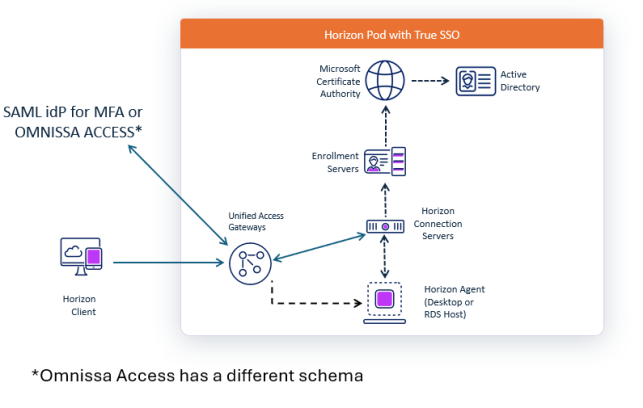
A diagram of a network

AI-generated content may be incorrect.

Here are more details on how to install the certificates (coming soon)

.

.

Wrapping It Up

Certificates might not be glamorous, but in an Omnissa Horizon + Omnissa Access environment they are foundational:

• They secure Connection Servers for internal trust.
• They harden UAGs with public-facing credibility.
• They power True SSO, giving users a smooth, passwordless experience.

Think of them as the quiet guardians of your virtual desktops: invisible when done right, but disastrous if ignored.

So next time you see a certificate renewal reminder, don’t sigh. Smile. Because your Horizon users—and your future self—will thank you.
.

SSL Certificates in an Omnissa Horizon + Omnissa Access World: Why They Matter More Than You Think

VMware Horizon 2106

VMware a few days ago released a new Horizon Version.
The new build 2106 (8.3) brings with it some very interesting features from some relating to the security of intellectual property to those related to the Teams collaboration tool, here is a list of those that I consider the most interesting:

  • Implementation of GPO for blocking the ability to take screenshots of VDI sessions from Windows and MAC Clients
  • Possibility in the instant clone to use the Microsoft Sysprep (this function slows down the deployment of an IC by performing a series of reboots)
  • Functionality for applications of run indefinitely
  • Possibility to use TrueSSO SAML authentication for non-Trust domains
  • Horizon Agent has support for Windows Server 2022 (Currently in Preview)
  • The Horizon Client for Linux has the optimization for Teams (as in some versions the functionality for the Windows client was present)
  • Cloud Burst support to extend your on-prem workload to the Cloud in case of a high load.

More details in this video

VMware Horizon 8 (2106) What’s New – YouTube

VMware Horizon 2106

Azure MFA, UAG, Horizon and TRUE SSO – Step 5

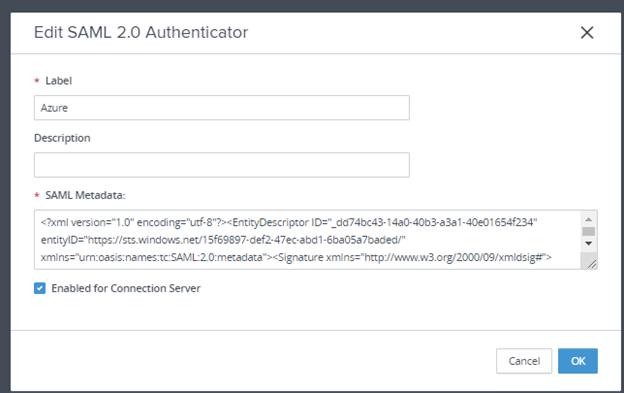
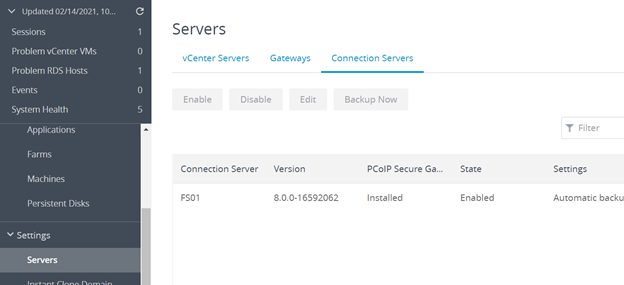
Import XML on Horizon Connection Servers and configure it

Now we import the XML content in to all Horizon Connection Server, for all server on

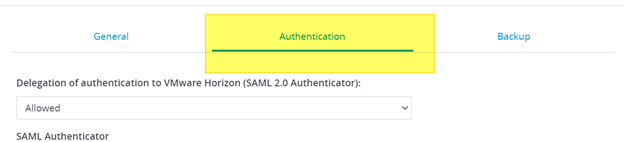
Select Edit and after authentication

Select in delegation of authentication ….. the value ALLOWED open

and a new authenticator

Static

Name type Azure

And copy the content of XML file  on the SAML Metadata

Enable truesso for Horizon Authentication method

On a Connection server enable the TRUESSO for a Authentication Method

vdmUtil –authAs admin-role-user –authDomain domain-name –authPassword admin-user-password –truesso –authenticator –edit –name authenticator-fqdn –truessoMode {ENABLED|ALWAYS}

vdmUtil –authAs administrator –authDomain pollaio –authPassword 121212121 –truesso –authenticator –edit –name azure  –truessoMode ENABLED

And now the configuration is done.

Thank You

Fabio Storni fabio1975@gmail.com

REFERENCE

Tutorial: Azure Active Directory single sign-on (SSO) integration with VMware Horizon – Unified Access Gateway | Microsoft Docs

Setting Up True SSO (vmware.com)

Azure MFA, UAG, Horizon and TRUE SSO – Step 5

Azure MFA, UAG, Horizon and TRUE SSO – Step 4

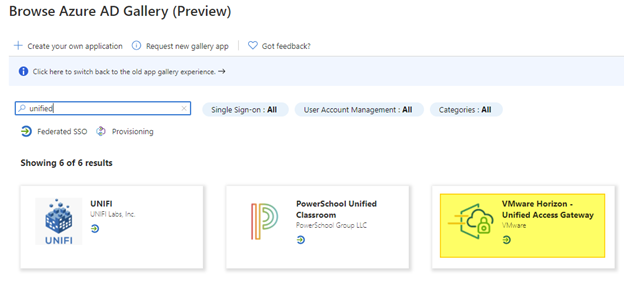
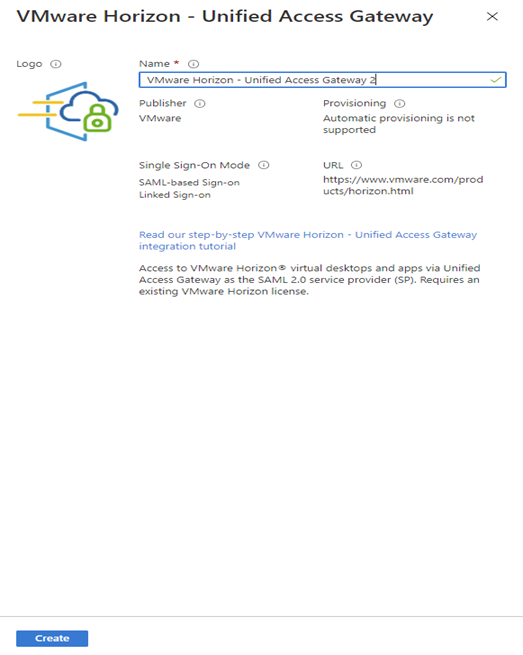
Configure a enterprise application on Azure AD, configure it and export XML

Insert:

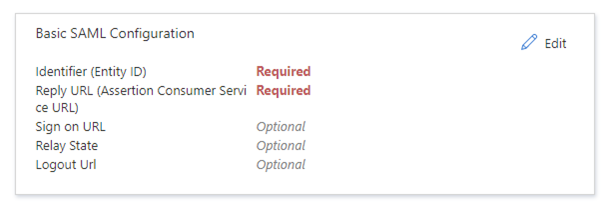
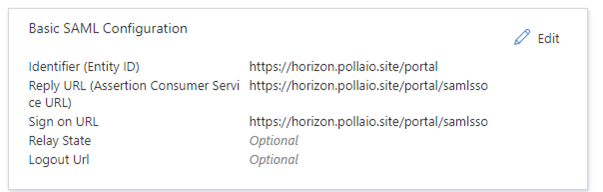
 Identifier  -> https://<public-FQDN-UAG>/portal

Reply URL -> https://<public-FQDN-UAG>/portal/samlsso

Sign on URL -> https://<public-FQDN-UAG>/portal/samlsso

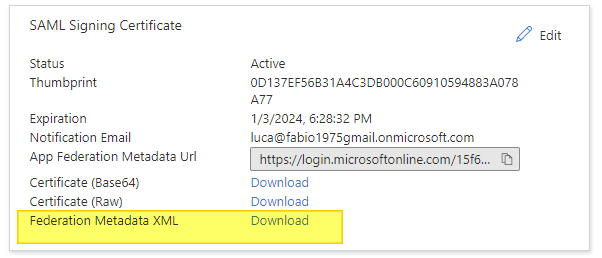
Download the  XML

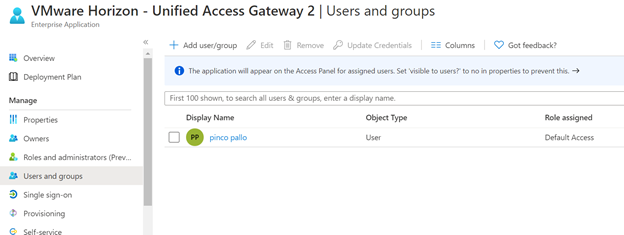
Assign Users or Groups permission to Enterprise application

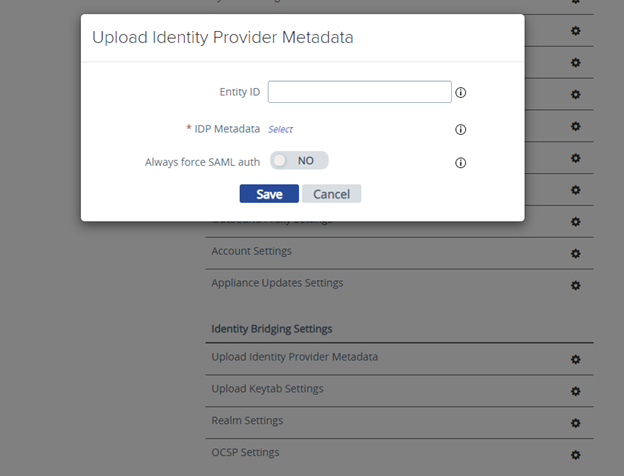
Import XML on UAG and configure it

Import Identity Provider Metadata, select the file XML downloaded from the Enterprise Application data

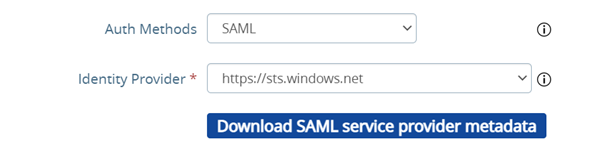
Select the identity provider

 Select More Option

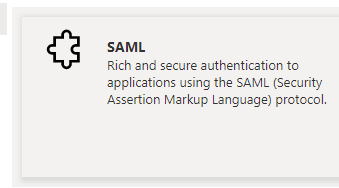
And select SAML e the correct Identity provider (with SAML+PASSTROUGHT the identity token  will not passed to horizon Server and it will required a new autentication)

Azure MFA, UAG, Horizon and TRUE SSO – Step 4

Azure MFA, UAG, Horizon and TRUE SSO – Step 3

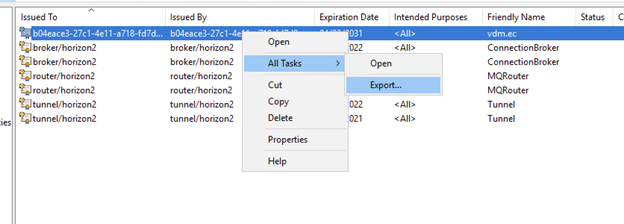
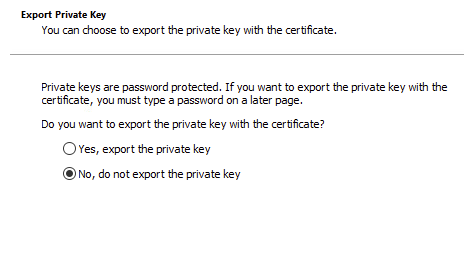
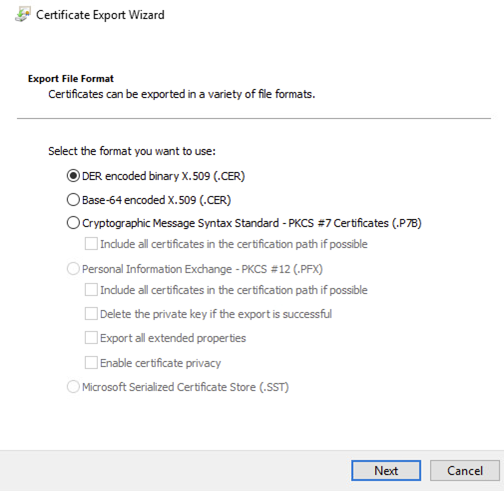
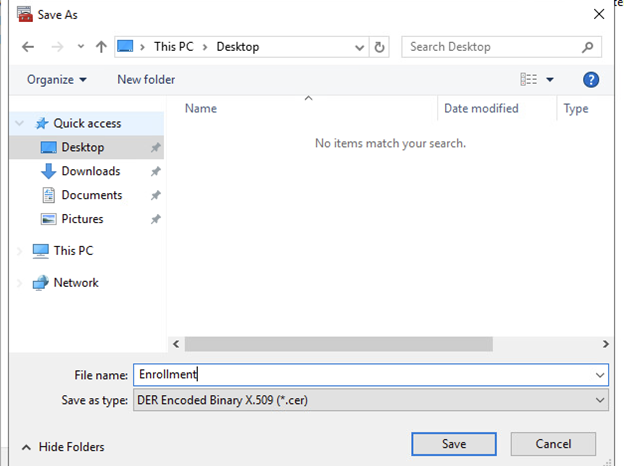
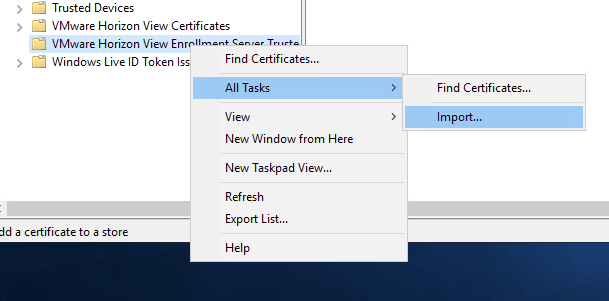
Export Horizon Enrollment Certificate from Horizon installation and install it in to Enrollment Horizon Server

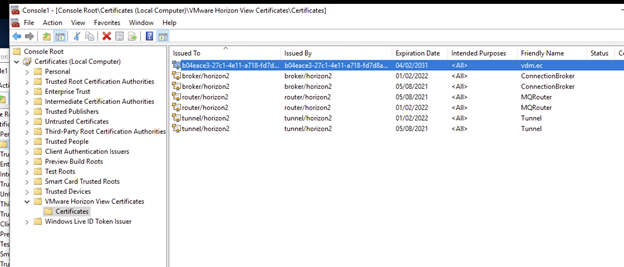
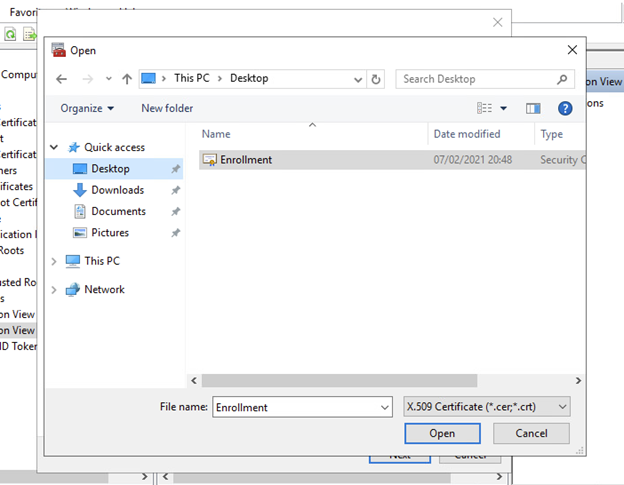
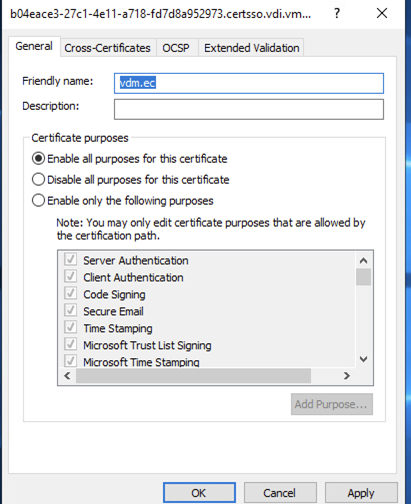
Connect to Horizon Server and export the Horizon View Certificate  (The certificate with  vdm.ec friendly name)

Now we import the enrollment certificate in to Horizon Enrollment server,  we need import in to Certificate Computer store and add the friwndly name vdm.ec

Configure TrueSSO on Horizon Connection Server

Configure Enrollement server

vdmUtil –authAs admin-role-user –authDomain domain-name –authPassword admin-user-password –truesso –environment –add –enrollmentServer enroll-server-fqdn

vdmUtil –authAs administrator –authDomain pollaio –authPassword qwerty1234567890! –truesso –environment –add –enrollmentServer Enroll.pollaio.lan

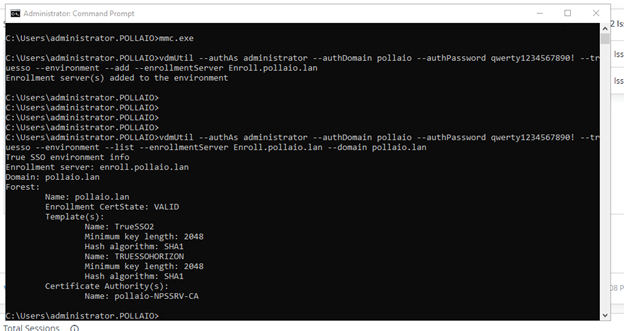
Verifica le informazioni

vdmUtil –authAs admin-role-user –authDomain domain-name –authPassword admin-user-password –truesso –environment –list –enrollmentServer enroll-server-fqdn –domain domain-fqdn

vdmUtil –authAs administrator –authDomain pollaio –authPassword qwerty1234567890! –truesso –environment –list –enrollmentServer Enroll.pollaio.lan –domain pollaio.lan

Creare la connessione per il true sso

vdmUtil –authAs admin-role-user –authDomain domain-name –authPassword admin-user-password –truesso –create –connector –domain domain-fqdn –template TrueSSO-template-name –primaryEnrollmentServer enroll-server-fqdn –certificateServer ca-common-name –mode enabled

vdmUtil –authAs administrator –authDomain pollaio –authPassword qwerty1234567890! –truesso –create –connector –domain pollaio.lan –template TRUESSOHORIZON  –primaryEnrollmentServer enroll.pollaio.lan –certificateServer pollaio-NPSSRV-CA  –mode enabled

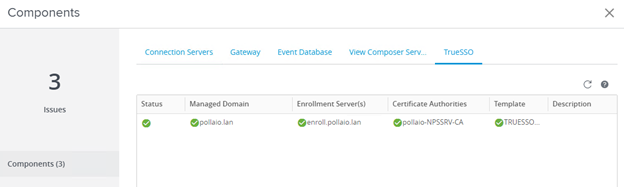
Verify from the Horizon Connection server dashboard thee TrueSSO status, if it is all green the trueSSO is Ready

Azure MFA, UAG, Horizon and TRUE SSO – Step 3

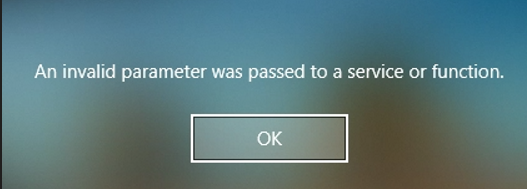
Error An Invalid Parameter was passed to a service of function” Horizon and TRUE SSO

 When i try to use TrueSSO and Horizon i find this error:


Horizon Windows Desktop or App fails with logon error: ‘an invalid parameter was passed to a service or function’ (79644) (vmware.com)


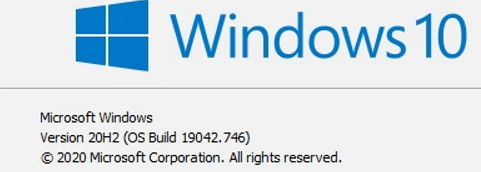
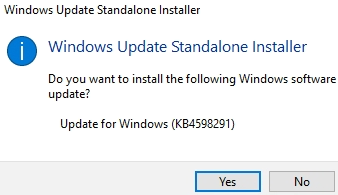
We have install the last windows 10 comulative update 


Fix it
Error An Invalid Parameter was passed to a service of function” Horizon and TRUE SSO